
- SafeAvon publicly accessible raw data held on Epicollect, can be accessed by following this link: https://five.epicollect.net/project/safeavon.
- To help with understanding the data, a live spreadsheet has been set up to present it in a more intuitive way. You can access and interact with the summary spreadsheet by following this link: https://docs.google.com/spreadsheets/d/10zcY2XL-ZTx03IdwKSJYTejASz6zjV0PdNzsSzveC80/edit?usp=sharing
This spreadsheet updates automatically as new data is uploaded to Epicollect. It is the definitive source of overview statistics like number of test sites, samples taken etc. It means that a specific test site can quickly access the full relevant dataset and see charts of how the variables are trending, and compare it with other test sites.
While the high level of nutrients (both phosphate and nitrates) show the water is polluted, it will not identify individual pollution events . You might instead use the graphs it generates to identify when there are spikes which could indicate a pollution event, and then look at nearby sites (found using the test sites map, to which there is a link in the spreadsheet) and see if the same spike can be seen elsewhere in the same week. Alternatively, you can simply extract the relevant data and pass it on to your MP, or other stakeholder as evidence to inform their discussions and decisions.
***
- Electrical Conductivity (EC): Conductivity is the ability of water to conduct electricity, which depends on the impurities in the water and is affected by temperature. Electricity is conducted by the available ions, or electrolytes, dissolved in the water, an increase or decrease, can indicate pollutants, affecting the quality of the water. A sewage leak increases the EC because of additional ions such as chloride, phosphate, and nitrate.
-
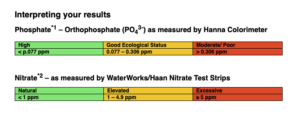
Nitrates: High levels of nitrate in water can be a result of runoff or leakage from fertilized soil, wastewater / sewage, landfills, septic systems, or urban drainage. In river water it often ranges from 0.01-3.0 mg/L (ppm).
-
Phosphate: Excessive phosphorus in surface water can cause explosive growth of aquatic plants and algae. This leads to a variety of water-quality problems, including low dissolved oxygen concentrations, which can cause fish to die & harm other aquatic life. It is a good measure of sewage pollution.
Taking immediate action if necessary, if you see any of the following:
• Pollution to water or land
• Damage or danger to the natural environment,
• Dead fish or fish gasping for air
• Collapsed or badly damaged riverbank
Environment Agency 24-hour Incident Hotline 0800 80 70 60
SafeAvon Report
Safe Avon Report – Alcester [pdf]
Safe Avon Report – Alveston [pdf]
Safe Avon Report – Ascott [pdf]
Safe Avon Report – Aston Magna [pdf]
Safe Avon Report – Aston on Carrant [pdf]
Safe Avon Report – Barton [pdf]
Safe Avon Report – Beckford [pdf]
Safe Avon Report – Bishampton [pdf]
Safe Avon Report – Bredon [pdf]
Safe Avon Report – Bredons Norton [pdf]
Safe Avon Report – Burmington [pdf]
Safe Avon Report – Cherington [pdf]
Safe Avon Report – Chipping Campden [pdf]
Safe Avon Report – Church Lench [pdf]
Safe Avon Report – Clifford Chambers [pdf]
Safe Avon Report – Draycott [pdf]
Safe Avon Report – Elmstone Hardwicke [pdf]
Safe Avon Report – Evesham [pdf]
Safe Avon Report – Fladbury [pdf]
Safe Avon Report – Flyford Flavell [pdf]
Safe Avon Report – Great Comberton [pdf]
Safe Avon Report – Great Wolford [pdf]
Safe Avon Report – Hampton Lucy [pdf]
Safe Avon Report – Henley-in-Arden [pdf]
Safe Avon Report – Ilmington [pdf]
Safe Avon Report – Langley [pdf]
Safe Avon Report – Long Compton [pdf]
Safe Avon Report – Lower Brailes [pdf]
Safe Avon Report – Lower Stour [pdf]
Safe Avon Report – Luddington [pdf]
Safe Avon Report – Napton (Expanded) [pdf]
Safe Avon Report – Napton on the Hill [pdf]
Safe Avon Report – Naunton Beauchamp [pdf]
Safe Avon Report – Newbold on Stour [pdf]
Safe Avon Report – Norton Lindsey [pdf]
Safe Avon Report – Peopleton [pdf]
Safe Avon Report – Pershore [pdf]
Safe Avon Report – Pinvin [pdf]
Safe Avon Report – Preston Bagot [pdf]
Safe Avon Report – Preston on Stour [pdf]
Safe Avon Report – Radford [pdf]
Safe Avon Report – Rous Lench [pdf]
Safe Avon Report – Shipston-on-Stour [pdf]
Safe Avon Report – Snitterfield [pdf]
Safe Avon Report – Southam [pdf]
Safe Avon Report – Stockton [pdf]
Safe Avon Report – Stretton-on-Fosse [pdf]
Safe Avon Report – Tewkesbury [pdf]
Safe Avon Report – Tiddington [pdf]
Safe Avon Report – Todenham [pdf]
Safe Avon Report – Twyning Green [pdf]
Safe Avon Report – Upper Stour [pdf]
Safe Avon Report – Warwick [pdf]
Safe Avon Report – Welford-on-Avon [pdf]
Safe Avon Report – Weston-on-Avon [pdf]
Safe Avon Report – Whichford [pdf]
Safe Avon Report – Willington [pdf]
Safe Avon Report – Winchcombe [pdf]
Safe Avon Report – Wyre Piddle [pdf]